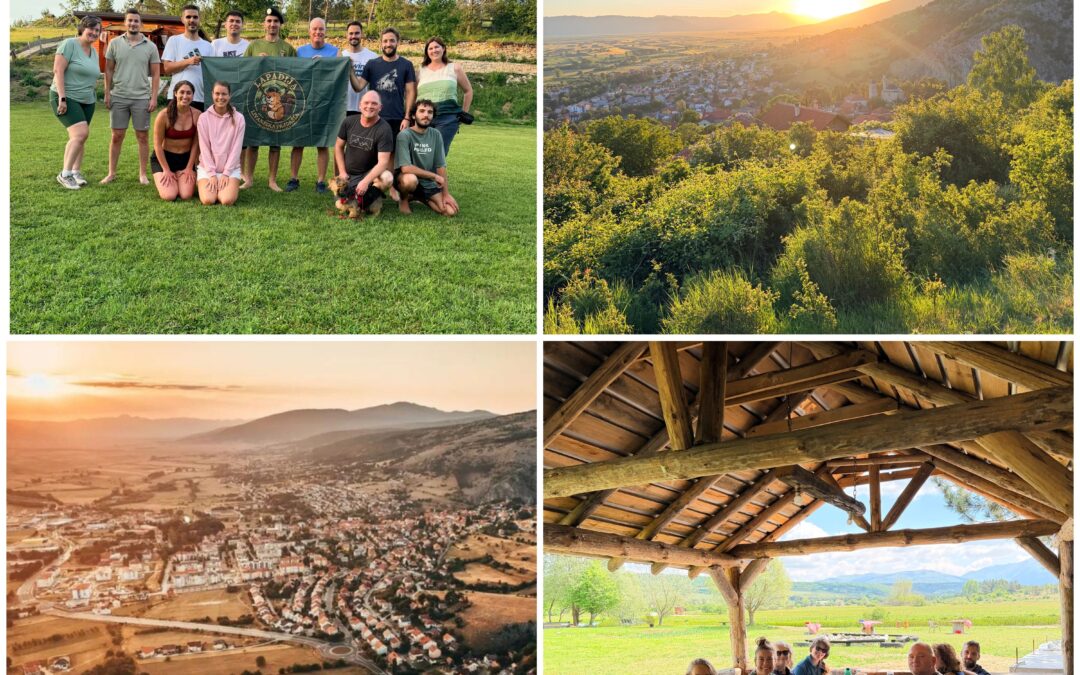
For the second time, we brought together a group of international remote workers in Livno, Bosnia and Herzegovina.
Over the course of three months, participants from countries including the United States, Canada, France, Germany, Spain, Belgium, the United Kingdom, and others chose to spend at least one month living and working in a destination that remains largely undiscovered by international visitors.
When many people think about digital nomads and remote work destinations, they immediately picture places such as Bali, Lisbon, Chiang Mai, or Medellín. These locations have become household names within the remote work community and continue to attract thousands of location-independent professionals every year.
Located in the southwest of Bosnia and Herzegovina, surrounded by mountains, valleys, and one of Europe’s largest populations of wild horses, Livno is not a destination that typically appears on lists of top remote work hubs. It receives relatively few international visitors compared to more established destinations and remains off the radar for most remote workers.
Yet that is precisely what made the experience so interesting.
Our goal was never simply to bring visitors to Livno. The objective was to explore whether remote workers could contribute positively to smaller destinations during quieter periods of the year while simultaneously benefiting from an authentic local experience.
The results exceeded our expectations.
The Community Aspect Became the Biggest Success
When organizing a workation, accommodation and coworking infrastructure are important. Reliable internet, comfortable living spaces, and suitable work environments are all necessary ingredients.
However, what ultimately shapes the experience is the people.
Over the three months, participants formed genuine friendships and strong bonds with one another. Many arrived without knowing anyone else in the group. Some came from large cities, others from rural areas. They represented different industries, cultures, and backgrounds.
Yet within a few weeks, a real community emerged.
Participants worked together during the day, shared meals in the evenings, organized hikes on weekends, and explored the surrounding region as a group. Some discovered common professional interests, while others simply enjoyed the opportunity to connect with people who understood the remote work lifestyle.
This sense of community is often overlooked when discussing remote work.
The ability to work from anywhere is valuable, but many remote workers also face challenges related to loneliness and isolation. Spending months working alone from an apartment can eventually become exhausting, even in beautiful locations.
The Livno experience demonstrated once again that people are not simply searching for a destination. They are searching for meaningful connections.
A Genuine Interest in Local Culture
Another pleasant surprise was the level of curiosity participants showed toward the local community.
Rather than remaining within an international bubble, many actively sought opportunities to learn more about Bosnia and Herzegovina and life in Livno.
Participants spent time in local cafés, restaurants, and shops. They attended local events, learned about the region’s history, and interacted with residents whenever possible.
Several expressed how refreshing it was to experience a destination that had not yet been heavily shaped by mass tourism.
Instead of feeling like tourists moving through a destination designed primarily for visitors, they felt welcomed into a real community where daily life continued much as it always had.
For many participants, this authenticity became one of the highlights of their stay.
In an era where some popular remote work destinations are struggling with overtourism and increasing tensions between locals and visitors, smaller towns like Livno offer a different model.
The relationship becomes more balanced.
Visitors are not arriving in overwhelming numbers. Instead, they become temporary residents who contribute to local life while respecting and learning from the community around them.
Addressing Seasonality Through Remote Workers
One of the most significant challenges facing smaller destinations across Europe is seasonality.
Many towns experience a strong influx of visitors during a few peak months of the year, followed by long periods of relative quiet.
This creates challenges for local businesses, accommodation providers, restaurants, and tourism stakeholders. Revenue becomes concentrated into a limited period, making long-term planning more difficult.
Remote workers offer an interesting alternative.
Unlike traditional tourists, they are not necessarily tied to holiday periods. Many have the flexibility to spend one, two, or even three months in a destination during the off-season.
They stay longer.
They spend locally over a longer period.
They become familiar faces rather than transient visitors.
And because they continue working while travelling, they can support local economies during months when tourism activity would otherwise be much lower.
In Livno, participants supported local accommodations, cafés, restaurants, grocery stores, and various service providers throughout the duration of their stay.
The economic impact of a single remote worker staying for one month is fundamentally different from that of a visitor staying for a weekend.
Multiply this by a group of international professionals over several months, and the impact becomes meaningful, especially for smaller communities.
International Visibility for Hidden Destinations
Another benefit often overlooked is visibility.
Most participants had never heard of Livno before discovering the workation opportunity.
By the end of their stay, many had shared photos, stories, videos, and experiences with their own networks.
Friends, family members, colleagues, and online communities suddenly became aware of a destination they had never previously considered visiting.
This kind of organic visibility can be extremely valuable for smaller towns that lack the marketing budgets of major tourism destinations.
Instead of relying solely on traditional tourism campaigns, destinations can benefit from authentic storytelling generated by people who have genuinely experienced the place.
The message becomes more credible because it comes from residents and visitors rather than advertisements.
Over time, this creates awareness that can continue generating interest long after a particular workation has ended.
Why Smaller Destinations Have an Opportunity
The success of the Livno experience raises a broader question.
How many smaller towns around Europe and beyond could benefit from attracting remote workers?
The reality is that many destinations already possess the ingredients necessary to welcome location-independent professionals.
Reliable internet is increasingly available.
Accommodation exists.
Local businesses are present.
Natural surroundings, cultural heritage, and authentic experiences are often abundant.
What is frequently missing is a structured way to connect these destinations with the growing global population of remote workers.
Many municipalities still view tourism primarily through the lens of short-term visitors.
Yet remote workers represent a different category entirely.
They are not simply tourists.
They are temporary residents.
They spend more time in a destination, contribute to local economies over longer periods, and often develop stronger connections with local communities.
For smaller destinations facing population decline, economic challenges, or strong seasonal fluctuations, this creates an opportunity worth exploring.
Building Connections That Matter
Perhaps the most rewarding outcome of the Livno workation was seeing meaningful relationships emerge.
Participants connected with one another.
Participants connected with local residents.
And a small town connected with people from across the world.
These connections are difficult to measure in economic statistics, yet they may be among the most important outcomes of all.
When people leave a destination with positive memories, friendships, and a deeper understanding of another culture, they become ambassadors for that place.
Some return.
Some recommend it to others.
Some maintain friendships that continue long after the workation ends.
In a world that often feels increasingly divided and disconnected, creating opportunities for genuine human connection has value far beyond tourism metrics.
Looking Ahead
The Livno experience reinforced our belief that remote work can create benefits for both travellers and destinations.
For remote workers, it provides an opportunity to discover places they might never otherwise visit, connect with like-minded people, and experience a deeper form of travel.
For destinations, it offers a way to diversify tourism, reduce seasonality, generate economic activity, and build international visibility.
As remote work continues to evolve, the conversation should not focus exclusively on major cities and famous nomad hubs.
Some of the most interesting opportunities may lie in smaller towns that have been overlooked until now.
The question is no longer whether remote workers are willing to spend time in destinations like Livno.
The question is how many other towns are ready to welcome them.