There is something particularly satisfying about returning to a destination that has gradually become part of the story of what we are building.
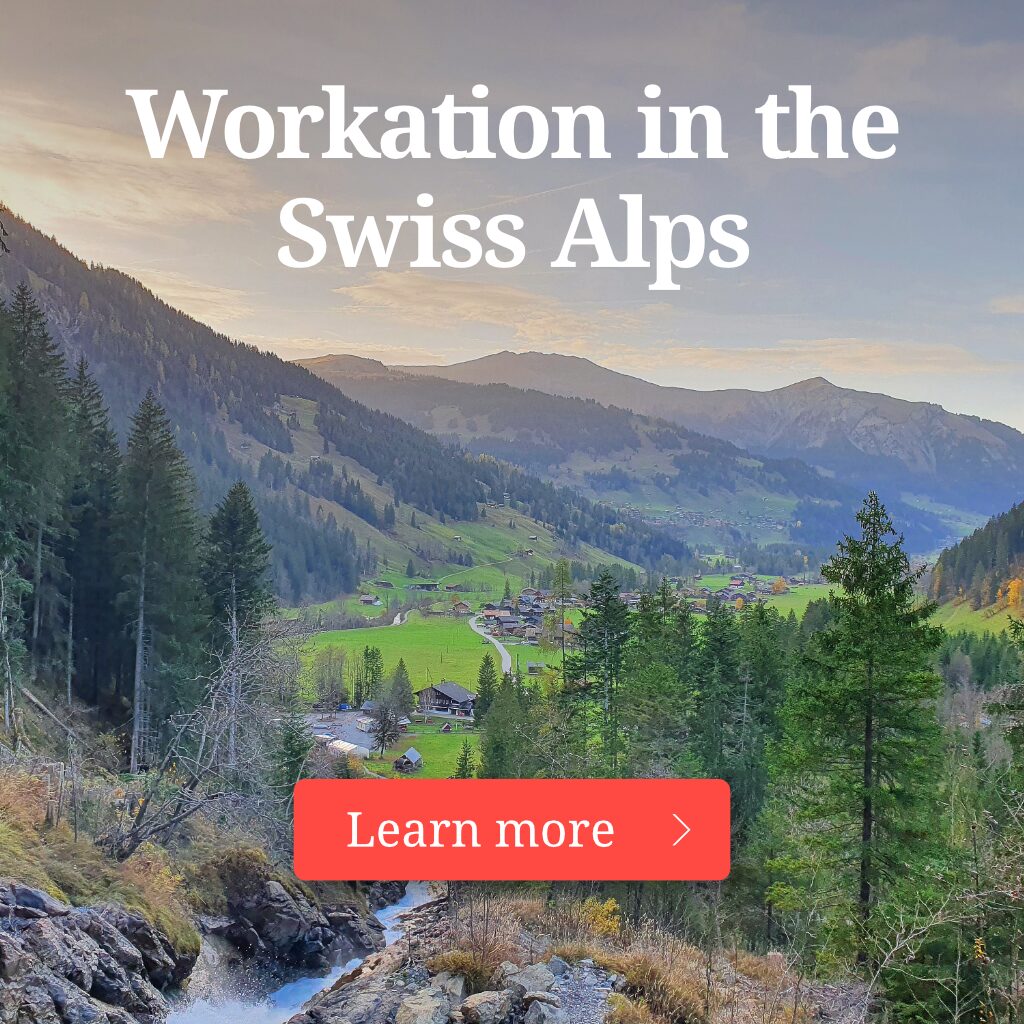
In September 2026, Hubs Travel launched its seventh workation edition in Lenk, a small Alpine village in Switzerland’s Bernese Oberland. What started in 2023 as an experiment around bringing remote workers together in the Swiss Alps has now developed into a recurring community, with editions taking place across different seasons and participants returning from around Europe and beyond.
Our latest edition runs from September 12 to December 18, 2026, with stays starting from 30 days.
The idea remains relatively simple: combine the privacy and comfort needed to live somewhere for a month or longer with the community that can otherwise be difficult to find when working remotely.
And Lenk continues to be one of the places where that combination works particularly well.
Why We Keep Coming Back to Lenk
Lenk is not a typical digital nomad hotspot.
There are no endless rows of laptop cafés, giant coworking campuses or nightlife districts full of remote workers.
That is partly the point.
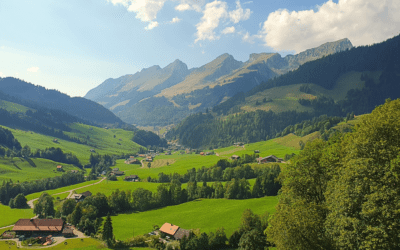
Lenk is a compact Swiss mountain village surrounded by the Bernese Alps. Hiking trails begin almost directly from the village, while supermarkets, restaurants, cafés, a pharmacy and the train station are all within walking distance of our accommodation.
For people spending one or several months somewhere, this creates a very different rhythm from a city break.
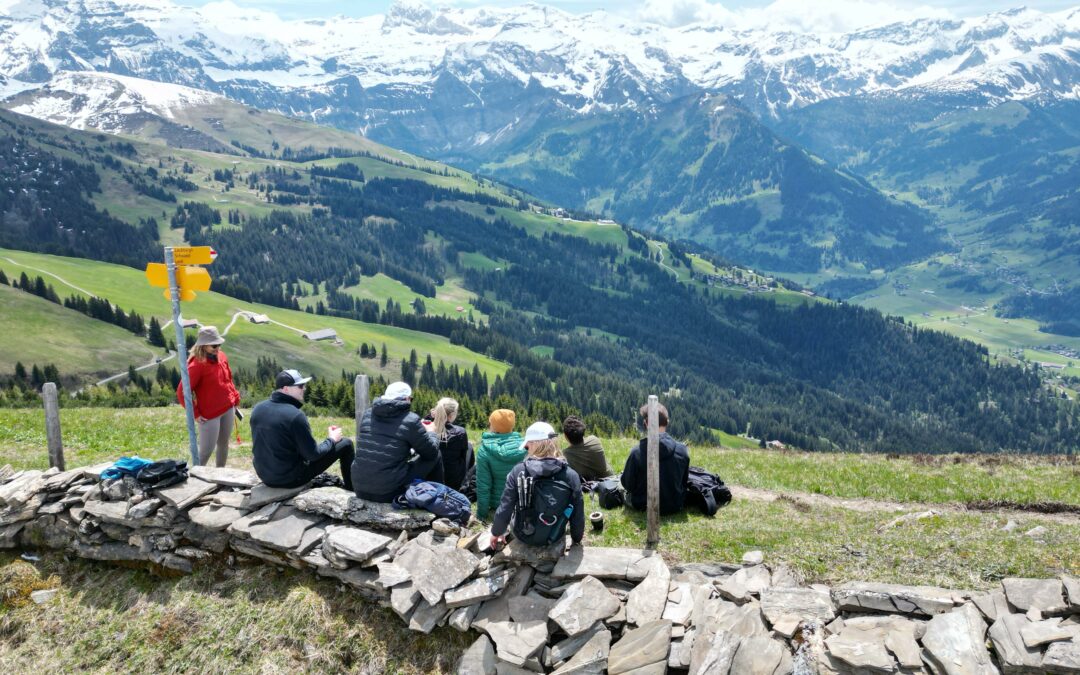
We can work normally during the day, go hiking after finishing work, have dinner with the community in the evening, and wake up surrounded by mountains the following morning.
There is also no need to rent a car for everyday life.
Participants receive a Simmental Card, which includes free use of local public transport across participating routes in the region. The official Adelboden-Lenk-Kandersteg tourism organisation confirms that guest-card holders can use local services in Lenk and several surrounding public transport routes free of charge.
That makes exploring the wider valley considerably easier during a longer stay.
From One Edition to Seven
Our first Lenk edition took place in autumn 2023.
Since then, we have continued returning for spring and autumn editions. The current Autumn 2026 workation is our seventh edition in Lenk, following editions in autumn 2023, spring and autumn 2024, spring and autumn 2025, and spring 2026.
That continuity has allowed the concept to evolve.
We have learned more about what people actually need when they spend one, two or even three months working from another destination.
It isn’t enough to provide a bed and Wi-Fi.
People need privacy.
They need somewhere comfortable to work.
They need reliable internet.
They need kitchens and laundry facilities.
They need quiet when they have an important meeting.
But they also want an easy way to meet other people without feeling obligated to participate in activities every day.
That balance between independence and community has increasingly become central to the Hubs concept.
For readers discovering the project for the first time, we previously wrote a more general guide to our workation in the Swiss Alps, including more information about Lenk and the origins of the project.
Private Accommodation, Rather Than Traditional Coliving Bedrooms
One aspect we have increasingly prioritised is privacy.
Participants can choose between private ensuite rooms, studios and larger apartments.
Private rooms provide access to a shared kitchen, while studios and apartments have their own fully equipped kitchens. The accommodation also includes dedicated workspaces and high-quality Wi-Fi.
This makes the workation accessible to different types of participants.
Someone travelling alone might choose an ensuite private room.
Someone who prefers complete independence when cooking may choose a studio.
Couples or people staying longer might prefer a one-bedroom apartment.
There are also larger apartments available.
This matters because a workation lasting one to three months is fundamentally different from attending a five-day retreat.
After several weeks, having personal space becomes much more important.
Community should be something we can easily join — not something we can never escape from.
Working From the Alps Still Means Working
The word workation can sometimes create the impression that people are mostly on holiday with a laptop nearby.
The reality is usually very different.
Participants have normal jobs and businesses to run.
There are developers, entrepreneurs, consultants, marketers, freelancers and remote employees having client calls, managing teams and completing the same work they would normally do from home.
That means the infrastructure has to support real working days.
Our buildings include several coworking and common areas, quiet working options and dedicated desks within the accommodation itself.
Internet reliability is particularly important. Anyone who has tried running an important video call from an unreliable holiday apartment understands why.
We recently explored this topic in detail in our guide to how much internet speed you actually need to work remotely. Raw Mbps numbers are only part of the story: stability, upload speed and the quality of the local Wi-Fi network can matter just as much.
In Lenk, the setup has been developed specifically around people who actually need to work.
The Community Part Happens Outside Working Hours
The other half of the experience begins when laptops close.
Participants are added to the community group and supported by on-site community managers. Activities develop around the group rather than following the schedule of a traditional organised tour.
That can include shared dinners, hikes, workshops, bonfires, fitness sessions or spontaneous plans between participants.
Some people participate frequently.
Others join occasionally.
Both approaches are completely fine.
This is one of the things we have learned after organising multiple editions: a good remote-work community does not need to schedule every hour of someone’s life.
Often, it is enough to put compatible people in the same place and make it easy for them to connect.
Someone suggests a hike on Saturday.
Another person proposes dinner.
A few people decide to visit another village.
Someone organises a workshop around something they know particularly well.
The community gradually becomes self-sustaining.
More Than Just Coworking
The shared facilities have also expanded beyond places to sit with a laptop.
Participants have access to common living spaces, a fitness room, boxing and yoga areas, shared laundry facilities with washers and dryers, and intermediary accommodation cleaning every two weeks.
Those things may sound relatively mundane compared with photographs of Alpine peaks.
But they matter enormously during a long stay.
A successful one-month workation is built as much around practical everyday life as around spectacular weekend experiences.
We wrote about this same principle recently when looking at how to choose accommodation for remote work: a beautiful property is not necessarily a good place to live and work for several weeks.
The best setup is often the one where everyday life simply works.
Autumn Is an Interesting Time to Live in the Swiss Alps
The current edition covers an unusually varied period.
Participants arriving in September experience the end of the warmer hiking season.
October brings autumn colours and cooler mountain weather.
By November and December, the surroundings gradually transition toward winter.
This makes the three-month edition very different from visiting Switzerland for one week.
Rather than seeing one snapshot of the Alps, longer-stay participants experience an actual seasonal transition.
And because people are staying rather than simply passing through, there is time to explore more slowly.
We do not need to fit every hike, village and viewpoint into a seven-day itinerary.
If the weather is bad this weekend, we can go next weekend.
That is one of the broader reasons we continue to believe in slower forms of travel for remote workers.
Switzerland Doesn’t Have to Mean a CHF 4,000 Monthly Rental
Switzerland has a well-deserved reputation as an expensive country.
Long-term accommodation in popular mountain destinations can be particularly expensive.
One objective of the Lenk editions has therefore been to make an extended Alpine stay more accessible than booking standard short-term tourist accommodation month by month.
For Autumn 2026, private rooms start from an average of CHF 700 per month for participants staying the full three months. Shorter stays have different monthly rates, and studios and apartments are also available for people who want more privacy.
The minimum stay is 30 days.
Utilities, access to the community spaces, coworking facilities, fitness areas, laundry and regular intermediary cleaning are included in the setup.
This also illustrates why longer stays can create a very different economic model for destinations.
Instead of trying to sell accommodation by the night at peak tourist rates, properties can fill rooms and apartments for months during periods when demand may otherwise be lower.
Participants get considerably better monthly economics.
The host gets longer occupancy.
And the destination receives visitors who spend money locally over several weeks rather than a weekend.
A Workation Without Giving Up Privacy
We continue to think this is one of the strongest aspects of the model.
Traditional coliving can be excellent for highly social travellers, but not everyone wants to share most aspects of daily life.
At the opposite extreme, renting an isolated apartment can become lonely surprisingly quickly.
Our preferred model sits somewhere between the two.
We have our own room or apartment.
We can cook privately if we choose a studio or apartment.
We can work from our own desk.
And we can close the door whenever we want.
But downstairs — or just a few metres away — there are other remote workers having the same experience.
That makes joining a hike, dinner or conversation much easier than trying to build a social network from scratch every time we move somewhere new.
Who Is the Lenk Workation For?
The community is not limited to people who describe themselves as digital nomads.
In fact, we increasingly find that the term covers only part of the audience.
Some participants travel continuously.
Others have a permanent home and simply want to spend one or two months somewhere different.
Some are freelancers.
Some run companies.
Others are full-time employees who are allowed to work internationally for part of the year.
There are solo travellers, couples and occasionally families.
What they generally have in common is fairly simple:
their work can travel with them.
And they would rather spend a month somewhere meaningful than move between hotels every few days.
Seven Editions Later, the Experiment Has Become Something More Permanent
When we launched the first Swiss Alps workation in 2023, there were plenty of unknowns.
Would remote workers actually want to live in a small Swiss mountain village?
Would people stay for a month?
Would they form a community?
Would they come back?
Seven editions later, we have much clearer answers.
Lenk will never become Lisbon or Bali — and we would not want it to.
Its strength is precisely that it offers something different.
It is quiet.
It is walkable.
The mountains are genuinely outside the door.
People can concentrate during the working day and still feel that they are somewhere extraordinary when the laptop closes.
Our seventh edition is now underway and continues until December 18, 2026.
Anyone interested in joining for a month or longer can find the current accommodation options, availability and practical details on the Hubs Swiss Alps Lenk workation page.
Seven editions in, Lenk feels less like an experiment.
It feels like one of our homes in the mountains.